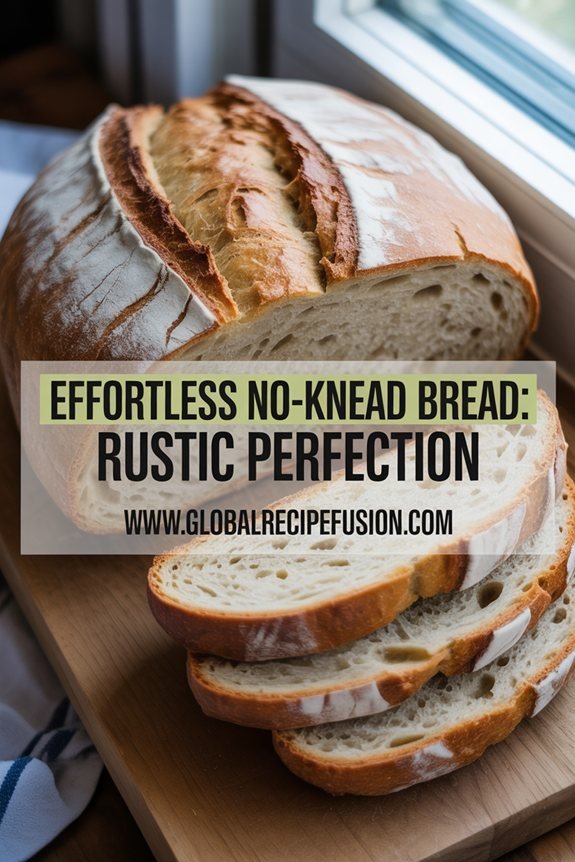
Why You’ll Love this Effortless No-Knead Bread
Three simple ingredients—flour, yeast, and salt—transform into bakery-quality artisan bread with almost no effort on your part.
You’ll be amazed as time does the work for you, developing complex flavors and that perfect crumb structure while you sleep or go about your day.
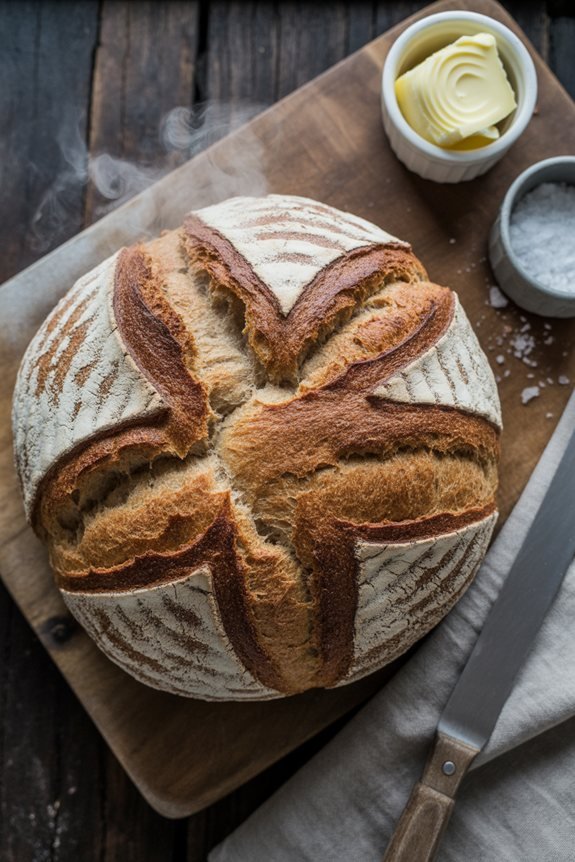
The crackling crust that shatters beneath your knife, revealing a tender, airy interior with those beautiful irregular holes that trap pools of melting butter—it’s pure magic.
No fancy equipment needed, just patience. This method transformed home baking for a reason.
It’s foolproof bread-making at its finest.
Recipe Information for Effortless No-Knead Bread
This groundbreaking bread-making technique originated in the New York Times, combining minimal handling with long fermentation to create artisan-quality bread that relies on time rather than kneading to develop gluten structure.
- Prep Time: 5 minutes (initial mixing)
- Rest/Rise Time: 14-20 hours (12-18 hour initial rest, plus 2 hour second rise)
- Cook Time: 45-60 minutes (30 minutes covered, 15-30 minutes exposed)
- Category: Bread
- Method: No-Knead Baking
- Cuisine: Artisan/European
- Yield: 1 loaf
What Ingredients are in Effortless No-Knead Bread?
The beauty of no-knead bread lies in its simplicity, requiring just four basic ingredients that transform through time and temperature into a crusty, artisanal loaf with an open, airy crumb. These pantry staples combine to create bread with complex flavor and texture that rivals professional bakeries, all with minimal effort.
- 3 cups all-purpose flour or bread flour, plus more for dusting
- 1/4 teaspoon instant yeast
- 1 1/4 teaspoons salt
- 1 5/8 cups water
- Cornmeal or wheat bran (optional, for dusting)
The type of flour you choose will affect the final texture of your bread. Bread flour, with its higher protein content, creates a chewier loaf with more structure, while all-purpose flour yields a slightly softer result. The minimal amount of yeast is intentional—the long fermentation allows even this small quantity to develop flavor and structure. For dusting, cornmeal or wheat bran adds texture to the crust and prevents sticking, though additional flour works well too if you don’t have those on hand.
How to Make this Effortless No-Knead Bread
The magic of no-knead bread happens through time rather than effort. The long fermentation process replaces traditional kneading, allowing gluten to develop naturally as the dough rests. This technique creates those beautiful air pockets and deep flavor that make artisan bread so special.
The process spans roughly 20 hours from start to finish, but your active time is minimal—just a few minutes of mixing and shaping, with patience doing the real work.
- In a large bowl, combine 3 cups of all-purpose or bread flour, 1/4 teaspoon instant yeast, and 1 1/4 teaspoons salt.
- Add 1 5/8 cups water and stir until blended, creating a shaggy, sticky dough.
- Cover the bowl with plastic wrap and let the dough rest at warm room temperature (about 70°F) for at least 12 hours, preferably 18 hours.
- When the dough surface is dotted with bubbles, it’s ready for shaping. Lightly flour a work surface and place the dough on it.
- Sprinkle the dough with a little more flour and fold it over on itself once or twice.
- Cover loosely with plastic wrap and let rest about 15 minutes.
- Using just enough flour to prevent sticking, gently shape the dough into a ball.
- Generously coat a cotton towel (not terry cloth) with flour, wheat bran, or cornmeal.
- Place the dough seam-side down on the towel and dust with more flour, bran, or cornmeal.
- Cover with another cotton towel and let rise for about 2 hours, until more than doubled in size.
- At least 30 minutes before the dough is ready, heat the oven to 450°F with a 6- to 8-quart heavy covered pot inside (cast iron, enamel, Pyrex, or ceramic).
- Carefully remove the hot pot from the oven, slide your hand under the towel, and turn the dough over into the pot, seam-side up.
- Cover with the lid and bake for 30 minutes.
- Remove the lid and continue baking for another 15-30 minutes, until the loaf is beautifully browned.
- Remove from the pot and cool completely on a rack before slicing.
A cast iron dutch oven provides ideal heat retention and distribution for creating that perfect crispy crust while keeping the inside tender and moist.
Once your golden-brown loaf has cooled and you’ve admired its rustic beauty, it’s time to consider how to showcase this artisanal creation for serving.
How to Plate this Effortless No-Knead Bread Like a Chef
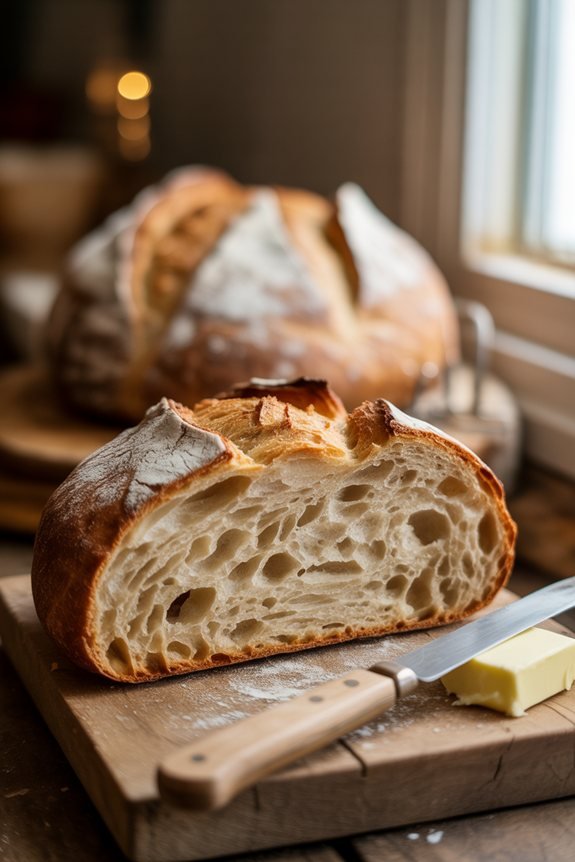
After you’ve perfected the art of baking this rustic loaf, presenting it becomes your moment to shine. Slice your bread on a wooden cutting board—that warm, earthy backdrop elevates its artisanal appeal.
Position it slightly off-center, surrounded by small dishes of cultured butter, flaky sea salt, and perhaps a drizzle of honey.
For dinner service, wrap the loaf in a simple linen cloth inside a shallow basket. The cloth absorbs excess moisture while maintaining that delightful crust.
When you ceremoniously unwrap it at the table, the aroma will fill the room, creating that quintessential breaking-bread moment families cherish for generations.
Effortless No-Knead Bread Substitutions and Variations
While perfecting the classic no-knead bread recipe gives you a foundation for incredible homemade loaves, embracing substitutions and variations transforms this humble dough into an endlessly versatile canvas for creativity.
You’ll love experimenting with flour blends—try substituting up to 1/3 of the all-purpose flour with whole wheat, rye, or spelt for deeper, nuttier flavors.
For a Mediterranean twist, fold in olives, rosemary, and lemon zest before the second rise.
Don’t have a Dutch oven? A heavy stainless steel pot with oven-safe lid works beautifully too.
The beauty of this recipe is its forgiving nature. Each variation creates something wonderfully different, yet similarly delicious.
What to Serve with Effortless No-Knead Bread
Now that you’ve perfected creating your perfect loaf, let’s consider what companions will make your freshly baked bread truly shine at the table.
This rustic bread begs for good butter—salted or unsalted, room temperature, maybe even cultured for tang.
Dip it in olive oil infused with herbs and garlic, or drag it through hearty soups and stews to soak up every last drop.
You’ll create magic pairing it with soft cheeses like brie or chèvre, or alongside a chunky tomato bruschetta.
It’s the perfect canvas for avocado, a simple sandwich, or that Sunday roast chicken dinner.
Final Thoughts
As you’ve journeyed through this no-knead bread adventure, you’ve revealed that baking isn’t just about following instructions—it’s about patience, trust, and a bit of kitchen magic.
This humble loaf, with its crackling crust and tender, airy crumb, represents something beautiful: simplicity triumphant.
You’ll find yourself making this bread again and again, tweaking it to suit your taste—perhaps adding herbs, olives, or cheese.
The New York Times recipe has democratized artisan bread-making, bringing it from professional bakeries into your kitchen.
There’s something deeply satisfying about creating such perfection with just flour, water, salt, and time.