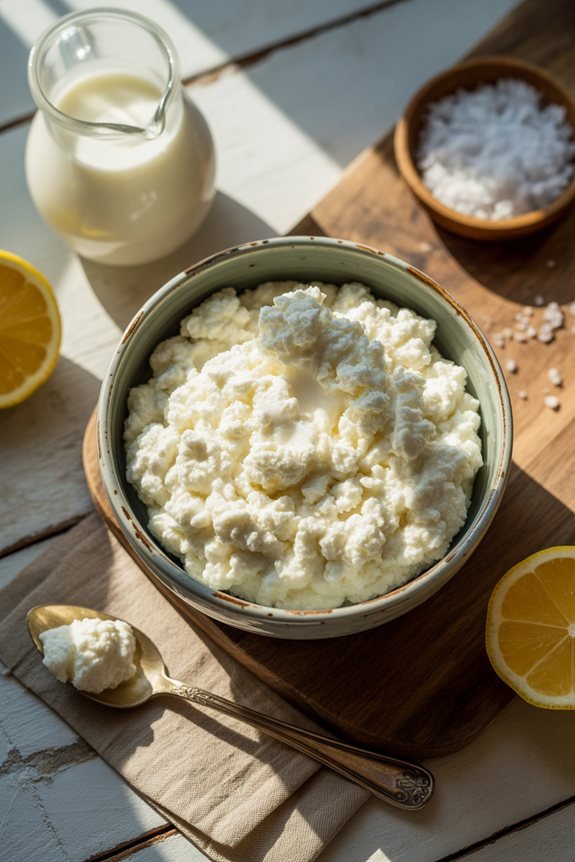

Why You’ll Love this Homemade Creamy Cottage Cheese
Once you’ve experienced the silky, cloud-like texture of homemade cottage cheese, you’ll wonder why you ever settled for the store-bought version.
There’s something deeply satisfying about transforming simple milk into delicate curds with just a splash of vinegar and a bit of patience.
You’ll adore the control you have over the final product—add more cream for richness or keep it lighter with milk. The fresh, clean taste is incomparable, without any preservatives or additives.
Plus, watching the magical moment when milk separates into curds and whey connects you to centuries of traditional cheesemaking.
Recipe Information for Homemade Creamy Cottage Cheese
This simple cheesemaking method transforms ordinary milk into delicate curds and whey, following a traditional technique that has been employed for generations to create fresh, unaged cheese.
- Prep Time: 10 minutes
- Cook Time: 30 minutes (plus 40 minutes cooling/draining time)
- Category: Dairy/Cheese
- Method: Curdling/Straining
- Cuisine: Traditional Farmhouse
- Yield: Approximately 2 cups of cottage cheese
What Ingredients are in Homemade Creamy Cottage Cheese?
Making homemade cottage cheese requires just a few simple ingredients that transform ordinary milk into delicious curds. This traditional recipe relies on the natural separation of milk proteins when acid is introduced, creating the characteristic texture and mild flavor that cottage cheese is known for.
- 1/2 gallon (8 cups) milk (2% recommended)
- 5 tablespoons vinegar
- Salt, to taste
- Milk or cream, added to achieve desired texture
The quality of milk you employ will directly impact the flavor of your final product. While 2% milk is recommended in this recipe, you could experiment with whole milk for a richer result or skim milk for a lighter version.
The amount of salt and cream added at the end is customizable based on your preference—add more cream for a smoother, creamier texture or less for a drier cottage cheese with more defined curds.
How to Make this Homemade Creamy Cottage Cheese
Creating homemade cottage cheese is surprisingly simple and requires minimal hands-on time. The process involves heating milk until it’s about to boil, adding vinegar to cause curdling, and then draining and rinsing the resulting curds. This method allows you to control the salt level and creaminess, producing a fresher taste than store-bought versions with no preservatives or additives.
- Heat 1/2 gallon (8 cups) of 2% milk in a pot until it’s just about to boil.
- Remove the pot from heat immediately when the milk reaches this point.
- Stir in 5 tablespoons of vinegar and watch as the milk begins to curdle.
- Set aside for 30 minutes to cool and fully separate. (Note: The whey will appear slightly greenish, which is normal.)
- Line a colander or sieve with cheesecloth and pour the curdled milk mixture into it.
- Allow the whey to drain naturally for several minutes.
- Gather the ends of the cheesecloth together and gently squeeze to remove additional whey.
- Rinse the curds by running cool water over them for a few minutes, gently stirring with your fingers.
- Allow to drain for an additional 10 minutes.
- Transfer the cheese to a clean container and stir in salt to taste.
- Add a splash of milk or cream to achieve your desired consistency and creaminess.
For a perfectly smooth and creamy cottage cheese, consider using a Vitamix blender to gently pulse the mixture to your preferred texture.
Now that your homemade cottage cheese is ready, let’s investigate how to present this simple but elegant dairy creation in a way that improves its appealing texture and fresh flavor.
How to Plate this Homemade Creamy Cottage Cheese Like a Chef

Presentation transforms your freshly made cottage cheese from a humble homemade creation into an impressive culinary statement.
I’m thrilled to share these plating secrets with you!
Scoop your cottage cheese into a shallow, wide bowl, creating a gentle mound. Drizzle with golden honey or fruity olive oil, letting it pool delicately around the edges.
Sprinkle with flaky sea salt, cracked pepper, or fresh herbs—dill and chives are perfect companions.
For brunch elegance, add sliced strawberries and a mint sprig.
Homemade Creamy Cottage Cheese Substitutions and Variations
While the basic cottage cheese recipe produces a delightful result, don’t be afraid to experiment with substitutions and variations that can transform this humble dairy creation into something extraordinary.
You’ll be amazed how a few tweaks can completely alter your cheese’s personality!
Try using lemon juice or buttermilk instead of vinegar for a different tang profile. For richer results, substitute whole milk or even add a splash of heavy cream to your final product.
Herbs like dill, chives, or basil create savory versions, while honey and fruit turn it dessert-worthy.
You’re designing a canvas for flavor—paint it boldly!
What to Serve with Homemade Creamy Cottage Cheese
Once you’ve crafted your perfect batch of creamy cottage cheese, what delicious companions will help it shine on your table? This versatile dairy delight pairs beautifully with both sweet and savory elements.
For breakfast, drizzle honey and sprinkle cinnamon over your cottage cheese, then add fresh berries or sliced peaches for a protein-rich start.
Looking for lunch? Spread it on crusty bread with cucumber and cracked pepper, or fold into pasta salads for creamy texture.
You’ll love it alongside tomato wedges sprinkled with herbs, or atop baked potatoes as a sour cream alternative.
Final Thoughts
After revealing how simple and rewarding it’s to make cottage cheese at home, you’ll likely never want to return to store-bought versions again.
There’s something deeply satisfying about transforming basic ingredients—milk, vinegar, salt—into a creamy, protein-packed delight right in your own kitchen.
You’re now part of a long tradition of home cheesemaking, connecting you to generations past.
Remember, your homemade creation won’t contain preservatives or additives, just pure, wholesome goodness.
The process itself becomes almost meditative—watching milk transform, squeezing the cheesecloth, and customizing to your exact preferences.